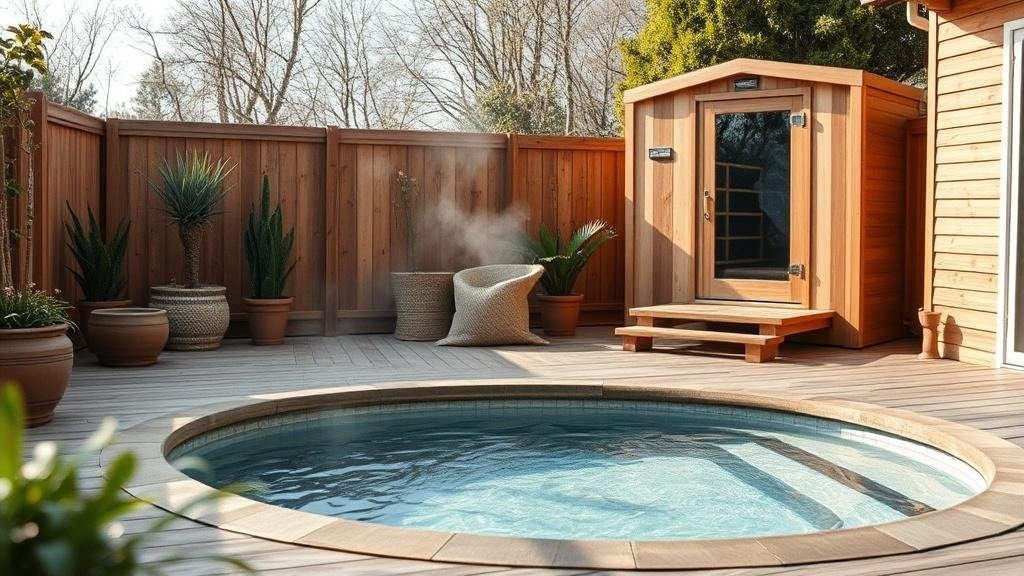
For the related article, the useful answer is practical: what makes the setup safe, comfortable, easy to maintain, and worth using when the novelty wears off.
A friend of mine in northern Minnesota, Pete, spent three weekends last fall building a barrel sauna on a gravel pad behind his detached garage. He’d budgeted $3,800 for the kit and figured that was the number. By the time he’d paid an electrician to run a 50-amp 240V line from his panel, poured a proper base after his first gravel attempt settled unevenly, and bought the accessories he hadn’t thought about (bucket, ladle, thermometer, floor duckboards), he was north of $5,600. He loves the thing. Uses it four nights a week. But the gap between the sticker price and the real cost is the single most common frustration I hear from people building outdoor saunas, and it’s the reason I wrote this piece the way I did: all-in numbers first, then everything else.
The Four Shapes and What Actually Differs Between Them
Outdoor saunas come in barrel, cabin, cube, and pod configurations. The names are mostly self-explanatory, but the real differences are less about aesthetics than about thermal behavior, footprint, and install complexity.
Barrel saunas (typically 6 to 8 feet long) heat fast because the curved interior has less dead air volume per square foot of bench space. They’re the cheapest to buy, the easiest to place, and the most forgiving on pad requirements. The tradeoff: limited headroom, awkward bench geometry for taller users, and the curved walls make interior modifications basically impossible.
Cabin saunas (6×6 up to 8×10) are the classic rectangular box. More usable interior space, flat walls you can mount a backrest or light fixture to, and a familiar building envelope that any contractor understands. They’re heavier, need a sturdier pad, and cost more. Mid-tier cabins with a quality Harvia or HUUM heater (6 to 9 kW) run $6,000 to $10,000 before install.
Cubes and pods are newer entrants, often with glass fronts or panoramic windows. They look great. They photograph well for Instagram. They also cost $12,000 to $16,980 in premium thermo-aspen or cedar builds, and the large glass panels change the thermal envelope in ways that matter: more heat loss, longer preheat, and condensation management becomes a real consideration in humid or cold climates.
The boring truth is that shape matters less than wood quality and heater sizing. Pre-cut tongue-and-groove cladding in cedar, hemlock, thermo-aspen, or redwood is the standard for a reason. Cheap kits that use butt joints with felt instead of tongue-and-groove will leak heat and look weathered within two seasons. That’s not a subjective opinion; it’s thermodynamics and moisture physics.
Reading the Spec Sheet Without Getting Fooled
Most spec sheets are designed to impress, not inform. Here’s what actually matters:
Heater-to-volume match. This is the single most consequential spec decision. An undersized heater runs constantly, shortens element life, and never quite reaches proper löyly temperature. An oversized heater cycles too hard and wastes electricity. Use the manufacturer’s published sizing chart. Forum advice from someone with a different climate, altitude, and insulation level is not a substitute.
Wood species and joinery. Already covered above, but worth repeating: tongue-and-groove or walk away.
Door hardware. Sounds trivial, isn’t. A sauna door opens and closes thousands of times a year in an environment of extreme temperature swings. Cheap hinges corrode. Magnetic latches (common on better Finnish-style doors) outlast mechanical catches by years.
For cold-plunge setups (since many outdoor sauna buyers are building contrast therapy stations), the equivalent checklist is chiller HP, filtration micron rating, ozone/UV sanitation, and tub material. A 1/3 HP chiller can hold 50°F in a small insulated tub in a temperate climate. Put that same chiller in a Phoenix garage in August and it will run itself to death. Climate context is everything.
What the Research Actually Shows
I’ll keep this section tight because the sauna-health literature is frequently overclaimed by marketers and under-read by buyers.
The landmark study is the Laukkanen 2015 cohort published in JAMA Internal Medicine. It followed 2,315 middle-aged Finnish men for 20 years and found a dose-response relationship between sauna frequency and reduced cardiovascular mortality. Men using a sauna 4 to 7 times per week had roughly half the cardiovascular mortality of once-a-week users. That’s a striking finding, but it comes with an obvious caveat: these were Finnish men with a lifelong sauna habit, and observational data can’t prove causation. A 2018 BMC Medicine follow-up from the same group reported lower dementia incidence at the highest sauna frequencies. The proposed mechanism involves heat acclimation, improved endothelial function, and a heart-rate response resembling moderate-intensity exercise.
For a home user, a reasonable starting protocol is 20-minute sessions at 170°F to 195°F, two to four times per week. Hydrate before and after. Step out if you feel lightheaded. This isn’t CrossFit; there’s no prize for suffering through dizziness.
Anyone with a cardiac history, uncontrolled blood pressure, or who is pregnant needs to clear sauna use with a physician before starting. Period.
Install: The Part Nobody Wants to Talk About
An outdoor sauna install is half carpentry, half electrical. Most reasonably handy adults can assemble a pre-cut kit with a helper and a weekend. I’ve seen it done in a day by people who read the manual first (a shockingly rare trait).
The electrical side is different, and this is the hill I will die on: do not DIY your 240V circuit. A typical traditional sauna heater pulls 4.5 to 9 kW on a dedicated 240V circuit at 30 to 50 amps. A licensed electrician should run the circuit, pull the permit, and tie into your main panel. Cutting corners on high-amperage wiring in a wooden structure that regularly hits 200°F is how house fires happen. Budget $600 to $1,800 for the electrical run.
Pad work comes first. A 4-inch compacted gravel pad with drainage works for a barrel unit on flat ground. A 4-inch reinforced concrete slab ($4 to $7 per square foot installed) is the better call for cabin saunas, especially in freeze-thaw climates or on soft soil. Pete’s settling problem in Minnesota? Classic soft-soil, poorly compacted gravel. A pad that shifts under a 1,200-pound cabin is expensive to fix after the fact.
Ventilation. An outdoor sauna needs a fresh air intake low on the wall near the heater and an adjustable exhaust high on the opposite wall. This is not optional; it’s how convective air circulation works inside the hot room. Skip it and you get stratified air (scorching at the ceiling, lukewarm at the bench) and stale, oxygen-depleted breathing.
Permits. Many jurisdictions treat sub-200-square-foot detached structures as exempt from building permits but still require the electrical permit for the 240V circuit. The only way to know your local rules is to call your building department before you buy the kit. A 5-minute phone call can save you a code violation.
All-In Costs, Because Sticker Prices Lie
Here’s what the full project actually costs:
Sauna units: $2,490 for an entry barrel kit. $6,000 to $10,000 for a mid-tier cabin with a quality heater. $12,000 to $16,980 for panoramic glass-front or premium thermo-aspen builds.
Pad: $400 to $900 for gravel. $1,200 to $2,400 for concrete.
Electrical: $600 to $1,800 for a 240V run.
Cold plunge (if you’re building a contrast station): $4,500 to $7,500 for a residential insulated tub with integrated chiller. $9,000 to $14,000 for commercial-grade stainless with full filtration. Stock-tank DIY setups run $400 to $900 but require manual ice, which gets old fast (like, second-week fast).
Appraisers won’t add dollar-for-dollar value for a backyard sauna, but a well-built outdoor wellness setup is increasingly treated as a selling feature in Northeast and Pacific Northwest markets.
On the tax question: a residential sauna is rarely HSA or FSA eligible unless a clinician issues a Letter of Medical Necessity for a documented condition. This is patient-specific. Talk to your tax advisor before counting on reimbursement.
Picking a Build: The Honest Framework
The fuller outdoor sauna resource I keep coming back to is the related article, which compares specs, pricing tiers, and installation considerations across the major form factors. It’s worth bookmarking before you commit to a build.
But here’s my actual opinion, for whatever it’s worth: the right outdoor sauna is not the cheapest one or the most expensive one. It’s the one that matches your climate, your available footprint, your electrical panel capacity, and (most importantly) the routine you will actually sustain. A $2,490 barrel sauna that you use four times a week beats a $15,000 glass-front cube that becomes a storage shed by March. Consistency is the variable that matters most, both for the health benefits the Laukkanen data suggests and for the simple return-on-investment math of cost per session over time.
Think of it like gym equipment. The best piece is the one you actually use. Everything else is furniture.
See also: Premium SEO Optimization 432440110 for Businesses
FAQs
How often does an outdoor sauna need maintenance?
Wipe down benches after each session and oil the exterior cedar or hemlock once a year. For cold plunges, replace filter cartridges every 6 to 12 weeks, run ozone or UV on schedule, and drain and refill per the manufacturer’s recommended interval.
Will my electric bill spike from an outdoor sauna?
A 6 kW sauna heater running for one hour costs roughly $0.60 to $1.20 at typical US residential rates. Three 20-minute sessions per week add about $4 to $8 per month. A 1/2 HP cold-plunge chiller in steady state pulls around 350 to 450 watts and adds $8 to $15 monthly in most climates.
Is an outdoor sauna safe during pregnancy?
Pregnant adults should not start a new sauna or cold-plunge routine without explicit clearance from their OB-GYN. Core temperature changes carry real fetal risks, particularly in early pregnancy. Defer to your physician on this one.
How loud is an outdoor sauna?
A traditional sauna heater is silent during operation. A cold-plunge chiller runs at roughly 45 to 55 dB at one meter, comparable to a quiet conversation. Be thoughtful about placement relative to neighbors and bedroom windows.
Can I run an outdoor sauna year-round in cold climates?
Yes, with caveats. Outdoor saunas are designed for cold weather and actually benefit from the thermal contrast, though you’ll want to budget for a longer preheat in deep winter. Cold plunges with insulated tubs and integrated chillers handle below-freezing ambient temps if the chiller’s operating range supports it. Check the manufacturer’s spec sheet for low-temperature performance before buying.
What’s the difference between a traditional and infrared outdoor sauna?
A traditional sauna runs at 170°F to 195°F using convective heat from a stone-topped heater. An infrared cabin operates at lower temperatures (120°F to 150°F) and typically plugs into a standard 120V outlet. They produce different physiological responses. The Laukkanen research was conducted with traditional Finnish saunas, not infrared units.
Do I need a permit for an outdoor sauna?
It depends entirely on your jurisdiction. Some municipalities exempt detached structures under 100 or 200 square feet from building permits but still require an electrical permit for any 240V circuit. The only reliable answer comes from your local building department.
Disclaimer. This article is general consumer information, not medical advice. Heat and cold therapies carry real cardiovascular load. Anyone with arrhythmias, uncontrolled hypertension, Raynaud’s phenomenon, recent cardiac events, or who is pregnant should consult a physician before starting any new sauna or cold-plunge routine.
Any 240V electrical work should be completed by a licensed electrician under the appropriate local permit.
HSA and FSA reimbursement on wellness equipment is patient-specific and depends on a Letter of Medical Necessity from a clinician. Talk to your tax advisor before assuming a purchase qualifies.